DoS Detection & Response
A machine-learning intrusion detector tested honestly — including on an attack it had never seen.
- Status
- Applied Machine Learning for Security Analytics — course project with paper, slides, code and trained models.
- Period
- 2026
- Platforms
- Python
- Repository
- View source
- Live
- —
01Overview
Classifies network flows from CIC-IDS2017 as benign or DoS, evaluates the classifier on held-out and out-of-distribution traffic, and drives a simulated automated response — flow blocking, alerting and firewall IP bans — from the model's predictions. Delivered with a research paper and presentation.
By the numbers
- F1 on held-out test
- 0.9989
- F1 on held-out test
- README §5.1
- false-positive rate
- 0.07%
- false-positive rate
- README §5.1
- unseen DDoS flows stopped
- 92%
- unseen DDoS flows stopped
- README
- innocent hosts banned (simulated IPs)
- 0
- innocent hosts banned (simulated IPs)
- README §6
02The problem
Intrusion-detection papers often report near-perfect scores on a random split of the same day's traffic — which says little about the next attack. The goal was a detector whose limits are measured, not hidden.
03The solution
Cleaning rules chosen from Wednesday only and applied unchanged to Friday; Destination Port dropped to prevent shortcut learning; duplicates removed to prevent leakage; a stratified 80/20 split with tuning inside training only; Friday's DDoS used once as an out-of-distribution test. A separate ALERT band in the response engine reflects the model's uncertainty.
04Key features
- 01
Held-out results
Random Forest on 116,996 never-seen Wednesday flows: precision 0.9985, recall 0.9993, F1 0.9989, false-positive rate 0.07% — 86 errors in total.
- 02
Generalisation, stated plainly
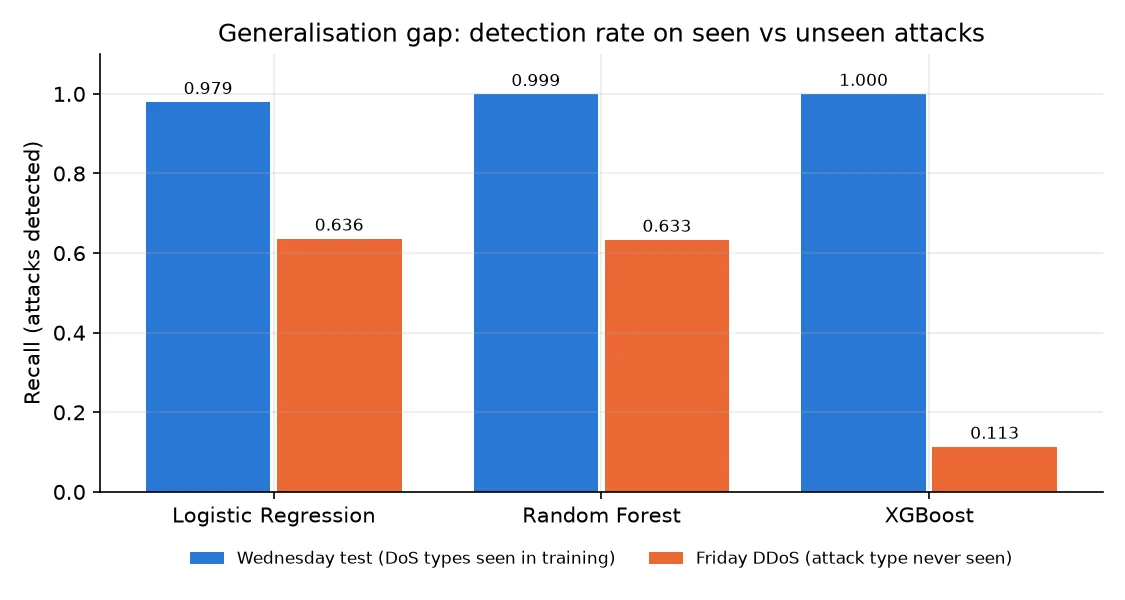
On the unseen Friday DDoS, recall per flow drops to 0.633 (precision 0.9994). XGBoost — marginally better on Wednesday — collapses to 0.113, which is why Random Forest was chosen.
- 03
Response that still works
Even with per-flow recall of 0.63, strike-based IP bans let the response layer stop 92.3% of DDoS flows and ban all 30 attacker IPs, with no innocent host banned. Source IPs are simulated — the dataset contains none.
- 04
Error analysis
Almost every error is a flow where the server sent no payload back — genuinely ambiguous. The model is uncertain on its errors (mean attack probability 0.29 for misses, 0.83 for false alarms).
05Screens
06System architecture
- L1Data
- CIC-IDS2017 CSV
- Cleaning → Parquet
- 584,980 flows × 66 features
- L2Modelling
- Dummy
- Logistic Regression
- Random Forest (3-fold CV)
- XGBoost
- L3Evaluation
- Held-out 20%
- Unseen Friday DDoS
- Per-attack recall
- Error profile
- L4Response
- Flow blocking
- ALERT band
- Firewall IP bans
- Generated rules
07Lessons learned
Report the test you might fail. The out-of-distribution number is the one that matters in production.
Technology
- Python
- scikit-learn
- XGBoost
- pandas
- Parquet
- Jupyter
- Random Forest
- Machine Learning
How this was verified
Code, README and results reviewed. Figures and terminal screenshots were produced by the project's own runs and are shown unaltered.
Related projects
- A
AI Agent Engineering — coursework
- MCP
- LangGraph
- A2A
- JSON-RPC
- Node.js
- React
- Anthropic API
- AI Agents
AI Agent Engineering — coursework
MCP servers, tool use, LangGraph multi-agent planners and the A2A protocol.
CourseworkAIResearch - Sسِراج
Siraj
- Kotlin
- Jetpack Compose
- Accessibility Service
- TensorFlow Lite
- WorkManager
- Hilt
- Room
- Machine Learning
Siraj
سِراجProtecting prayer time from social media — and reviewing your digital footprint, honestly.
PrototypeAndroidAIML 
Wakeel
وكيلAn AI employee that answers a business's customers on WhatsApp, Instagram and Messenger — in their own Arabic dialect.
BetaSaaSAIWeb
Next project
Athar