Kaffكفّ
Grab a file with your fist, open your palm at the other phone — and it moves. Offline.
- Status
- Six development phases complete; first field-testing round done on real phones.
- Period
- 2026
- Platforms
- Android
- Repository
- Private — available on request
- Live
- —
Kaff
- CameraX
- MediaPipe HandLandmarker
- GestureEngine
- Send VM
- Receive VM
- Fist → grab
- Palm 700 ms → accept
- SendController + reducer
- ReceiveController + reducer
- Nearby BYTES + FILE
- MediaStore
- SHA-256 verify
- Room history
01Overview
On-device hand tracking recognizes a fist to pick up a file and an open palm, held for 0.7 s, to accept it. Files travel peer-to-peer over Google Nearby Connections (Bluetooth bootstrap, then Wi-Fi Direct), behind a 4-digit pairing code, and every file is verified with SHA-256 before it is saved.
By the numbers
- measured, 500 MB over Nearby
- 12.5 MB/s
- measured, 500 MB over Nearby
- docs/DECISIONS.md
- JVM tests
- 104
- JVM tests
- README
- Kotlin files
- 113
- Kotlin files
- source tree
02The problem
Sending a file between two phones next to each other still means apps, accounts, cables or the internet. The gesture should be as physical as handing something over.
03The solution
MediaPipe HandLandmarker (GPU with CPU fallback) feeds a gesture engine; transfer logic is a pair of pure send/receive state machines over Nearby BYTES + FILE payloads, and MediaStore saving with integrity checks.
04Key features
- 01
Pairing before anything moves
Both phones show the same 4 digits; nothing is accepted until the receiver confirms. The gesture is a trigger, not an identity check.
- 02
Integrity
SHA-256 and size verified while saving; corrupted files never appear in the gallery. Up to 20 files per transfer.
- 03
Power aware
Camera auto-timeout, ~15 fps on battery saver, paused when the phone is hot.
- 04
Gesture Lab
Live skeleton, raw and confirmed gesture, scores, handedness, palm facing and FPS — for tuning sensitivity on any device.
05Screens
No screenshots exist for this project yet, so it is presented through its architecture rather than invented screens.
06System architecture
- L1Perception
- CameraX
- MediaPipe HandLandmarker
- GestureEngine
- L2Flow
- Send VM
- Receive VM
- Fist → grab
- Palm 700 ms → accept
- L3Transfer
- SendController + reducer
- ReceiveController + reducer
- Nearby BYTES + FILE
- L4Storage
- MediaStore
- SHA-256 verify
- Room history
07Technical challenges
The palm worked in the lab, not on a real phone
Field testing on an OPPO Reno13 F (Android 16) found three causes: a 1–1.5 s camera cold start inside a 5 s window, 'this time only' camera grants silently expiring on ColorOS, and a palm-facing check rejecting angled hands. The receiver now warms the camera as soon as a sender pairs, the window is 7 s, and the palm-facing check is off by default.
08Lessons learned
Measure on the worst phone you can find; it sets the ceiling.
My contribution
Design, gesture engine, transfer protocol and field testing — 15 commits.
Technology
- Kotlin
- Jetpack Compose
- Material 3
- CameraX
- MediaPipe
- Nearby Connections
- Hilt
- Room
- DataStore
- Coroutines
- Flow
- kotlinx.serialization
- MockK
- Turbine
- Computer Vision
How this was verified
Source, README, protocol and decision log reviewed, including field-test notes and speed measurements. Screenshots are still placeholders in the project, so none are shown.
Related projects
- A
AirControl Pro
- Kotlin
- Jetpack Compose
- MediaPipe
- CameraX
- Hilt
- Room
- Accessibility Service
- Computer Vision
AirControl Pro
Control your phone with hand gestures in the air.
PrototypeAndroidAI - Wوصلة
Wasla
- SyncEngine
- UdpDiscovery
- TcpServer
- Framing
- PairingKey
- Room
- Android clipboard bridge
- Desktop clipboard bridge
- Crypto.android
Wasla
وصلةA shared clipboard between phone and PC — Kotlin Multiplatform, peer-to-peer, encrypted.
PrototypeAndroidDesktop 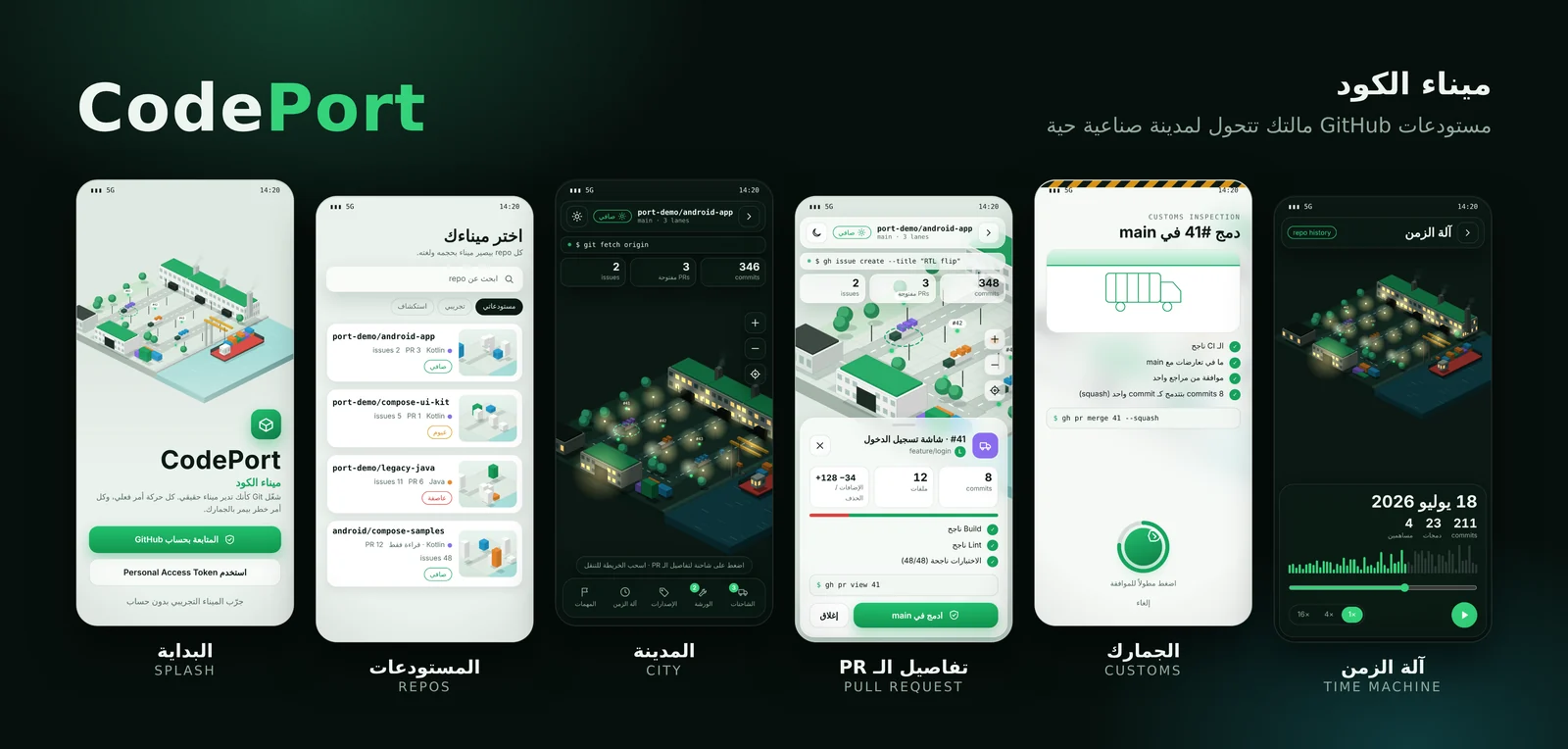
CodePort
ميناء الكودA GitHub repository as a living isometric port city — every gesture runs a real Git command.
PrototypeAndroid
Next project
SUBZERO